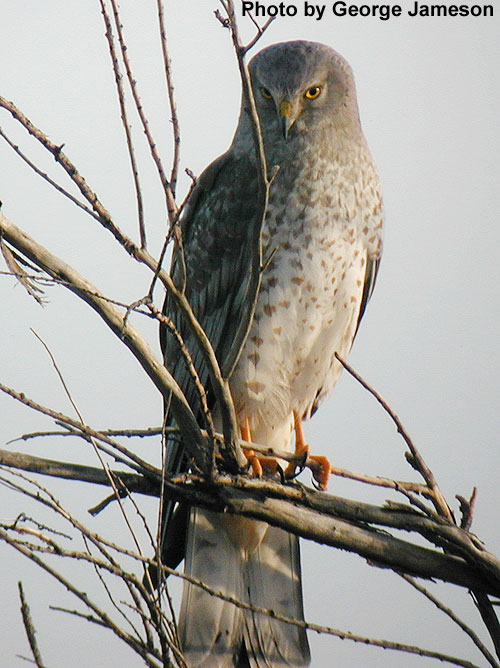
Photo by George Jameson
Take a walk down Lake Street in the Mendocino Headlands in the evening to watch the sunset and your attention will divert to a low-flying hawk with a distinctive white rump and long, barred tail, the Northern Harrier, or Marsh Hawk. Other ramblers in Europe and Asia watch this same species but they call it the Hen Harrier. Whatever we call this species, its preference for open space such as marshes, meadows, pastures, and wetlands, and its low flight with wings set in a dihedral make it a snap to name. Take a closer look and you will see the owl-like facial disk due to the presence of "filo feathers" that focus prey noises into large, off-set ears enabling the bird to use triangulation of sound to help locate prey. This characteristic, and soft feathers for a quieter flight, facilitates twilight hunting and locating prey in areas of higher grass which limit the predator’s vision.
Harriers show a greater difference between male and female plumage than typical of raptors. Females, brown above with varying degrees of brown and buff streaking below contrast with males, gray above with an unmarked lighter color below. Few raptors share this sexual dimorphism. Juveniles are brown above and plain orange-brown below. The northern harrier wing span of about 4 feet enables it to fly at 24 to 38 mph low over the ground at about 10-30 feet in a pattern of a few beats followed by a short glide, wings held slightly up in a V shape. It drops quickly to its prey.
The availability of the species’ principal prey in spring, usually voles, strongly influences annual breeding numbers and productivity. Northern Harriers also consume other small vertebrates, including snakes, frogs, passerine birds, and small waterfowl notably Eared Grebes, Phalaropes and even teal. Females take larger prey than the smaller males.
Like most other harriers, the Northern Harrier nests on the ground, usually in tall, dense clumps of vegetation, either alone or in loose colonies. The female will lay 4-5 pale blue eggs,sometimes marked with light brown spots.
Most males are monogamous or simultaneously bigamous, although some males pair with up to five mates in a season. The abundance of food in spring, and, to a lesser extent, the sex ratio, influences the frequency of polygyny. Females incubate eggs and brood offspring, and males provide the bulk of food for their mates and nestlings.
Harriers choose a new mate each breeding season. The male attracts potential mates by “sky dancing.” He swoops down from 60-100 feet to about 10 feet, then climbs back up and repeats the maneuver.
The nest of dead reeds or grasses blends into other tall plants. The female will lays 4-5 pale blue eggs, sometimes marked with light brown spots. The incubation period is 31-32 days and chicks fledge at 30-35 days. During the nesting period the male does most of the hunting while the female watches the nest and her chicks. The female feeds the chicks, tearing the prey into small manageable pieces. If the female dies during the time the chicks are dependent on her for food, they will usually die as well. The male will bring prey to the nest but will not tear it into pieces, and the chicks starve. Northern Harriers spend approximately 50% of the day searching for prey. They might fly up to 100 miles in a day in search of foo
One of the most amazing aerial acts I have witnessed occurred by the Point Cabrillo Light House. After a successful hunt, a male Northern Harrier called his mate from the nest. She flew beneath him as he released the vole, turned upside down in flight, caught the corpse, and rolled back all in one smooth action. As fine a piece of acrobatics as any raven dancing on the updraft on the bluffs of Lansing Street.
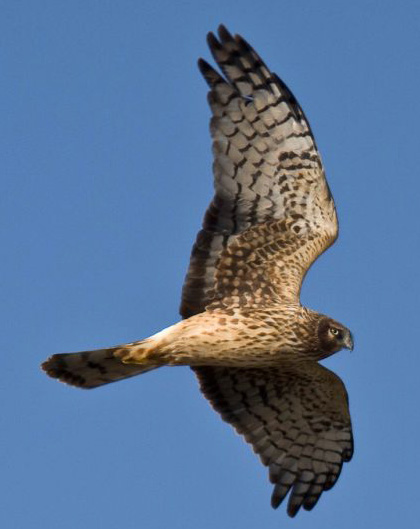
Photo by Ron LeValley
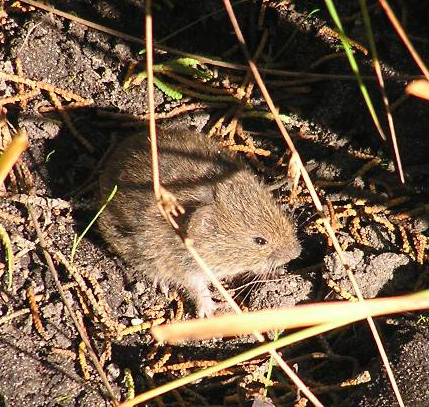
Photo by Don Shephard
Back to ... Mendocino Coast Audubon Society Newsletter Articles 2009-2012 | Home page